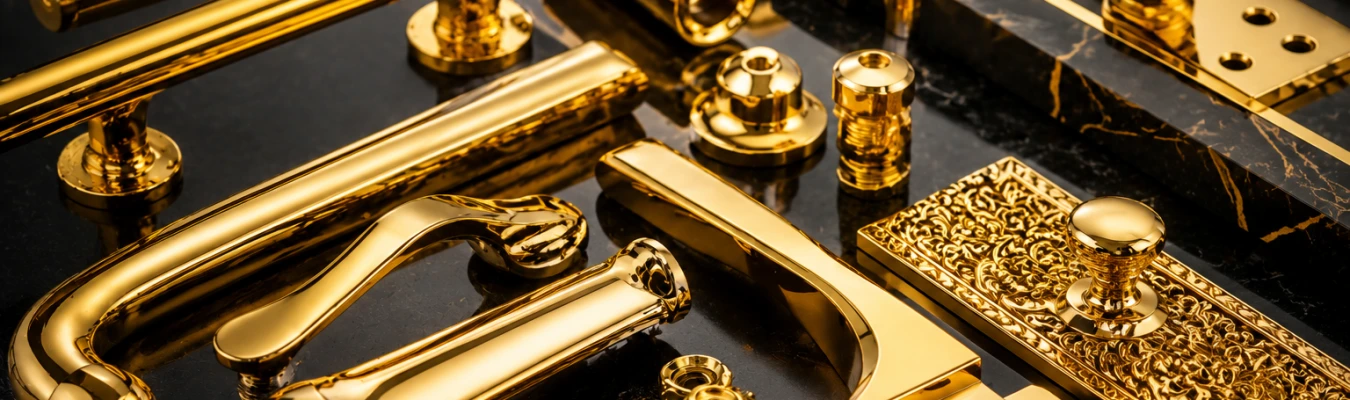
Two gold-plated door handles can look identical on delivery day and behave very differently a year later.
The difference is rarely the gold itself. Thickness, the layer underneath, and the gold type decide which gold plating benefits a part actually gets.
Gold plating is a surface treatment with six main benefits. They are a lasting appearance, durability, electrical conductivity, corrosion resistance, heat tolerance, and lower cost than solid gold. Each one holds only when the plating is specified to match the job. This guide shows what each benefit requires, so you can brief a plater correctly.
For the definition and the process, read our pillar guide, what is gold plating.
At Al Asriah Metal Coating in Sharjah, we plate gold over a nickel undercoat and set the thickness for each item. We also polish parts before and after plating. The advice below draws on that work and on published standards, including ASTM B488, the specification for engineering gold coatings.
In This Article:
- Why Is Gold Plating Popular for Surface Protection?
- What Are the Main Benefits of Gold Plating?
- Why Do Gold Plating Benefits Fail on Some Parts?
- How Thick Should Gold Plating Be for a Durable Finish?
- Which Gold Plating Benefit Matters Most for Your Part?
- What Should You Tell Your Plater to Get These Benefits?
- Frequently Asked Questions
Why Is Gold Plating Popular for Surface Protection?
Gold is popular for surface protection because it is unreactive: air, moisture, and most chemicals leave it unchanged.
That is why plating shops use it on jewellery, antiques, ornaments, automotive parts, and electronic components. As a precious metal surface coating, it goes on as a thin gold finish over a cheaper base metal, usually with nickel between the two.
That nickel underlayer can be built up to a thickness that suits the project. The base metal and nickel supply the bulk, so cost stays down while the gold delivers its benefits.
Six benefits come out of that combination, and each one carries a condition.
What Are the Main Benefits of Gold Plating?
Buyers choose gold for six reasons, and the table shows what each one needs from the specification.
| Benefit | Why gold delivers it | What must be true |
|---|---|---|
| Appearance | Gold keeps its colour because nothing on the surface reacts | A barrier layer under the gold and a polished base metal |
| Quality and durability | Gold is ductile and resists fretting from vibration | Hard gold or a heavier layer wherever parts slide or rub |
| Electrical conductivity | Gold forms no oxide film, so contact resistance stays low | The right gold type, with hard gold where contacts engage repeatedly |
| Oxidation and corrosion resistance | Gold is a noble metal and does not oxidise | A continuous, low-porosity layer over a nickel barrier |
| Heat tolerance | Gold melts above 1,000 degrees Celsius and forms no oxide when heated | An undercoat and base metal that cope with the heat, and a thicker layer for intense exposure |
| Lower cost than solid gold | A micron-scale gold layer sits over a cheaper base and nickel underlayer | Thickness matched to the duty, so you pay only for the gold the part needs |
The right-hand column holds the conditions that gold finishes fail on, so it deserves a closer look.
Why Do Gold Plating Benefits Fail on Some Parts?
Four common causes explain why a gold finish underperforms, and the specification and preparation control most of them.
- Thin gold is porous. Very thin layers contain tiny pores, and moisture travels through them to the base metal. A nickel underlayer reduces the effect of those pores, and ASTM B735 exists as a test method for porosity in gold coatings.
- The base metal migrates into the gold. On copper, silver, and copper alloys such as brass, atoms diffuse up through the gold and tarnish the surface. Copper moves more slowly than silver, and a nickel barrier is the usual remedy.
- Soft gold wears through. Pure gold is soft, so abrasive cleaning and constant handling remove thin layers first.
- Poor preparation blocks adhesion. Grease, oil, and residue stop the gold bonding, and the layer lifts or looks patchy. We clean and polish every part before plating for that reason.
Electrical parts add one more trap. Gold layers thinner than 0.5 micron can dissolve completely into solder. Solder with more than about 4 to 5 percent gold can turn brittle, so a soldered part needs a thickness chosen for the joint.
Knowing how gold plating fails makes the thickness question much easier to answer.
How Thick Should Gold Plating Be for a Durable Finish?
Thickness strongly affects how long a benefit lasts, and it is measured in microns.
| Trade term | Gold thickness | What it suits |
|---|---|---|
| Flashed | Under 0.5 micron | Appearance only, very limited wear |
| Plated | 0.5 micron and above | Decorative pieces with light handling |
| Heavy plated | 2.5 microns and above | Parts handled or rubbed every day |
| ASTM B488 engineering classes | 0.25 to 5.0 microns, in seven classes | Functional coatings, each class a minimum thickness |
Trade terms come from the jewellery industry and vary between suppliers. Some call anything under 0.175 micron flash, others anything under 0.5 micron, so ask for the number and not the label. In jewellery, Sourcify notes that sub-micron plating is common unless a thickness is specified.
Ask how the thickness is checked, too. ASTM B488 treats each class number as a minimum, not an average, and recognises non-destructive methods such as X-ray fluorescence and beta backscatter.
Thicker gold costs more because it uses more gold, but a layer matched to the duty still costs far less than solid gold. Sharretts Plating notes that gold can cost more than some other finishing methods yet pay back through a longer service life.
Worn pieces also need mechanical buffing and polishing before plating, and that work is part of the quote.
Once the thickness is settled, the remaining choice is which benefit to put first for your kind of part.
Which Gold Plating Benefit Matters Most for Your Part?
The answer changes with where the part lives and how people touch it.
- Jewellery, antiques, and ornaments. Appearance leads, even on very small pieces. Display pieces can carry a thin layer, but anything worn or handled needs the heavier end of the thickness table.
- Bathroom and hotel fittings. Taps, mixers, and shower accessories face water, cleaning products, and daily handling, so corrosion resistance and wear protection lead. Humid UAE conditions add to the moisture load.
- Lighting. Chandeliers and ceiling lights depend on colour stability and heat tolerance, and they rarely see abrasion, so a lighter decorative layer can suffice.
- Door hardware. Handles, locks, and hinges are touched all day, so wear protection decides how long the finish lasts.
- Automotive and electronic parts. Car trim needs corrosion resistance and a lasting finish. Electronic contacts need stable contact resistance, which points to the right gold type and thickness, while switch plates are mostly decorative.
- Heavy industrial wear. For hydraulic cylinders, rollers, and dies, hard chrome plating is the better finish.
Longevity was the reason behind our gold-plated Quran, which we published as the first in the UAE. You can read about it in our gold-plated Quran project.
Whatever the part, a plater can only match these benefits to it if you share six facts.
What Should You Tell Your Plater to Get These Benefits?
A precise brief is the cheapest way to protect the finish.
- The base metal. Copper and brass need a nickel barrier, and some metals need extra preparation.
- How the part is used. Say whether it is handled, rubbed, heated, or carrying current.
- The environment. Humid bathrooms, salt air, and cleaning chemicals all shorten life.
- The gold type. Soft gold suits wire bonding and high purity, while hard gold suits wear and repeated contact. ASTM B488 defines them through purity types and hardness codes.
- The thickness in microns, and where. Deep recesses and tight grooves receive a thinner layer than flat faces.
- The finish. State the shine and polish level you expect.
Send us your part and these details, and we will confirm the thickness and undercoat before we quote. Request a gold plating quote or see our gold plating services in Sharjah, Dubai, and the UAE.
The questions below cover what buyers ask once a quote arrives.
Frequently Asked Questions
Why does gold plating turn dull or discoloured?
The usual causes are a thin or porous layer, copper or silver migrating through the gold from the base metal, and abrasive cleaning. A nickel barrier and a heavier layer address the first two, and gentle cleaning addresses the third.
Does thicker gold plating always last longer?
Not always. More gold means more material to wear through, but hardness, the undercoat, preparation, and how the part is used matter just as much.
How can I check the thickness of gold plating?
Ask the plater for a thickness reading. X-ray fluorescence and beta backscatter are non-destructive methods recognised in ASTM B488, and the class numbers in that standard are minimum values.
Is gold plating the same as gold coating?
Gold coating is a broad term. Electroplating deposits gold with an electric current, while other methods include paint and spray finishes, electroless or immersion gold, and vapour deposition. ASTM B488 covers only electrodeposited gold.
Is gold plating expensive?
It costs more than some finishes but far less than solid gold. Price depends on surface area, thickness, and preparation, so a quote is more accurate than a price list.