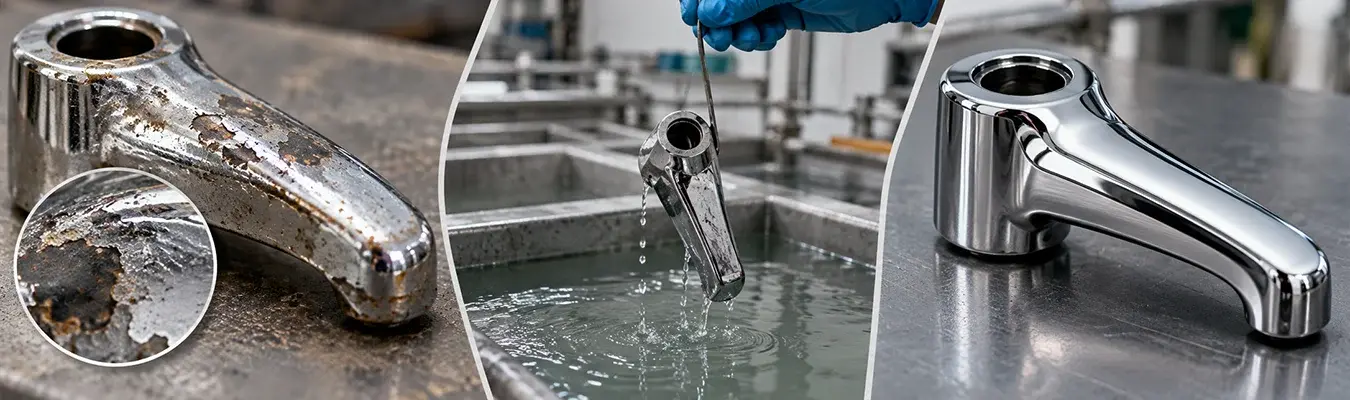
A mould that sticks, rusts, or wears at the edges loses production time long before it fails.
Chroming a die or mould means electroplating a hard chromium layer onto the tool surface. Industrial chroming, also called hard chrome plating, helps parts release, resists wear, adds corrosion protection, and makes the tool easier to clean. The result depends on thickness, surface finish, and the steel underneath.
Al Asriah Metal Coating is a chrome plating company in Sharjah. Our chroming specialists work on dies and moulds for the plastic industry and other manufacturers, offering chrome plating in Dubai, Sharjah, and across the UAE.
See our hard chrome plating services for the full range. This guide explains what chroming does, how thick it should be, and what to prepare.
In This Article
- What Does Chroming Do for Dies and Moulds?
- How Thick Should Mould Chrome Be?
- What Should You Prepare Before Plating Moulds?
- When Should You Re-Chrome a Die or Mould?
- What Should You Ask a Chroming Company?
- Frequently Asked Questions
What Does Chroming Do for Dies and Moulds?
Chroming gives a tool five practical gains, and how far each goes depends on the plating specification.
- Easier release – Chromium has low surface energy, so plastic parts eject more easily. Chrome-plated injection moulds are common for this reason.
- Wear resistance – The deposit is very hard and low in friction, so cavities, inserts, and shut-off faces last longer.
- Corrosion protection – According to Products Finishing, about 5 microns (0.0002 inch) on a mirror-finished mould surface can prevent oxidation on a sweating mould.
- Easier cleaning – Chrome resists sticking and caking, so cleaning takes less time.
- Lower cost over time – Longer tool life means fewer replacements, and worn tools can be re-chromed.
There is one limit. Products Finishing notes that an acid gas from degrading PVC is beyond what chrome resists, so corrosive resins need extra care. For the wider picture, see the benefits of hard chrome plating.
Thickness decides how far each gain goes.
How Thick Should Mould Chrome Be?
Thickness is measured in microns, and the right figure depends on the job.
| Job | Chrome thickness | Source |
|---|---|---|
| Wear and atmospheric corrosion | 5 to 10 microns (0.0002 to 0.0004 inch) | Products Finishing |
| Chemical attack | 13 to 50 microns (0.0005 to 0.002 inch) | Products Finishing |
| Flash on inserts and cavity blocks | 2.5 to 13 microns (0.0001 to 0.0005 inch) | Meadville Plating |
Suppliers set these ranges differently, so confirm the figure for your resin and tool. Thicker is not always better, because hard chrome does not level and more thickness amplifies existing roughness and defects.
Chrome also deposits unevenly. It builds up on edges and thins in recesses, so deep cavities may need auxiliary anodes.
Ask for the thickness in microns and how it is measured.
Surface finish and steel condition decide whether that thickness performs.
What Should You Prepare Before Plating Moulds?
Plating moulds well starts before the tool reaches the tank.
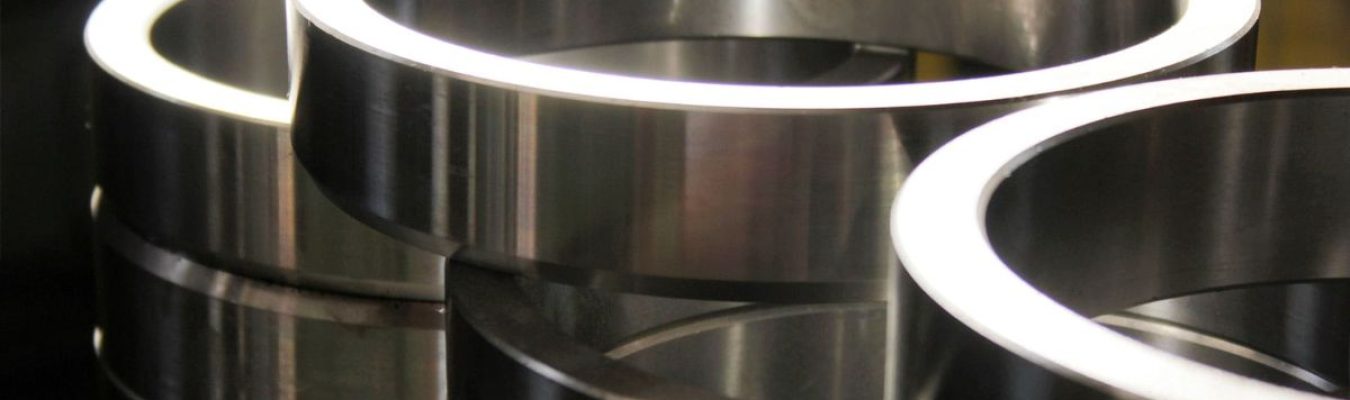
- Polish first – Hard chrome reflects the finish beneath it, so a mirror finish before plating gives a mirror finish after.
- Allow for the build-up – Plating adds thickness, so tell the plater which dimensions are critical. Parts can be over-plated and ground to size.
- Flag the steel hardness – Many hardened tool steels are above about 31 HRC, the level at which ISO 9587 and ASTM B850 recommend hydrogen relief baking, according to Pavco. Baking usually runs at 190 to 220 degrees Celsius for 3 to 24 hours, and it should start within a few hours of plating.
- Describe the geometry – Deep cavities, sharp corners, and recesses change how the chrome deposits.
Even a well-prepared tool wears eventually, so know when to re-chrome it.
When Should You Re-Chrome a Die or Mould?
Re-chroming is worth planning for, because chrome supports repeated refurbishment cycles. Watch for these signs:
- Parts stick or need more ejection force than before.
- Oxidation or pitting appears on a sweating mould.
- Shut-off faces wear and flash starts to appear on parts.
- The chrome looks dull, worn through, or flaking.
Hard chrome can also rebuild worn dimensions, because the part is plated thicker and then ground to size. Refurbishing can cost less than replacing a tool, so compare both.
Choosing the right chroming company decides how well that refurbishment goes.
What Should You Ask a Chroming Company?
Six questions help you compare chroming companies.
- Which chrome type? Hard chrome suits tooling, while decorative nickel chrome is thin and meant for appearance.
- What thickness, in microns? Ask how it is checked.
- What finish before and after? Chrome reflects the surface beneath it.
- Is hardened steel baked after plating? Ask about hydrogen relief.
- How are deep cavities handled? Ask about anodes and uneven build-up.
- Can they handle your tool size and volume? We chrome a single die or a full production line.
Send us your tool details and a photo, and we will advise on thickness and finish before we quote. Request a chroming quote.
The questions below cover what buyers raise before they send a tool.
Frequently Asked Questions
Is chroming a mould the same as plastic chrome plating?
No. Chroming a mould plates the steel tool so plastic parts release easily. Plastic chrome plating puts a decorative chrome layer on the plastic part itself.
Is chroming the same as chromate conversion coating?
No. Chroming electroplates a layer of chromium onto the part. Chromate conversion coating is a chemical film that forms on metals such as zinc and aluminium.
Does chrome protect moulds used for PVC?
Only partly. Chrome helps, but an acid gas from degrading PVC is beyond what chrome resists, so discuss the resin with your plater.
Does chroming change mould dimensions?
Yes. Plating adds thickness, so tell the plater which dimensions are critical. The part can be ground or polished back to size.
How long does mould chrome last?
It depends on the resin, the number of cycles, the thickness, and how the tool is cleaned. Worn chrome can be refreshed by re-chroming.