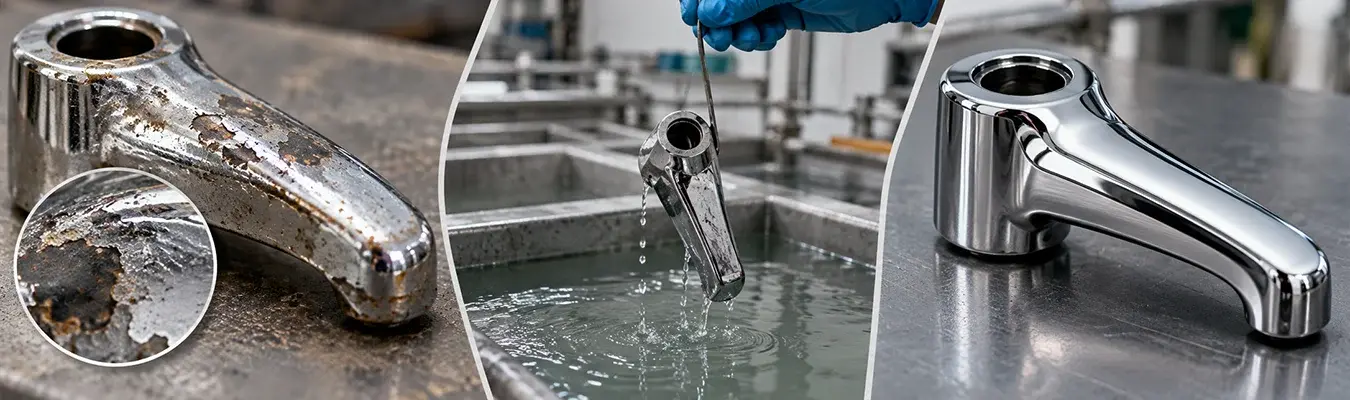

A metal component can be strong enough for its application and still fail prematurely because its surface is exposed to corrosion, wear, friction, or harsh environmental conditions.
This is why surface finishing plays an important role in many industrial and commercial applications.
Nickel chrome plating is one of the most widely recognized metal finishing systems, combining a nickel layer with a thin chromium layer to improve surface appearance and, depending on the coating system and service conditions, corrosion resistance and durability.
The familiar bright finish seen on automotive components, sanitary fittings, hardware, machinery parts, and decorative metal products is often associated with nickel-chromium plating. But the process is more than simply adding a shiny chrome layer.
The performance of the finished component depends on factors such as substrate preparation, nickel layer design, chromium type, coating thickness, surface condition, adhesion, and the environment in which the part will be used.
In this guide, we’ll explain what nickel chrome plating is, how the process works, the main types, where it is used, its benefits and limitations, and the standards that may apply when specifying a nickel-chromium coating.
What Is Nickel Chrome Plating?
Nickel chrome plating is an electroplating process in which a nickel coating is deposited onto a prepared substrate and is then covered with a chromium layer.
In decorative applications, the chromium layer is generally thin. Much of the corrosion protection and appearance is achieved through the underlying nickel system, while the chromium provides the characteristic bright, hard, wear-resistant outer surface.
A typical decorative system may involve:
Base metal → surface preparation → copper (where required) → nickel → chromium
Not every component requires every layer. The coating system depends on the substrate, desired appearance, corrosion resistance, service environment, and applicable specification.
ISO 1456 specifically covers decorative electrodeposited coatings of nickel, nickel plus chromium, copper plus nickel, and copper plus nickel plus chromium on substrates including steel, iron, zinc alloys, copper alloys, and aluminium alloys. It also provides coating designations based on service conditions.
How Does Nickel Chrome Plating Work?
Nickel chrome plating uses electrolysis to deposit metallic coatings onto a conductive component.
The part being plated acts as the cathode in an electroplating circuit. When electrical current passes through the plating solution, metal ions are reduced and deposited onto the component’s surface.
However, good nickel chrome plating starts long before the part enters the plating bath.
Step 1: Inspection and Surface Preparation
The first stage is inspecting the component and preparing its surface.
Oil, grease, rust, oxides, dirt, old coatings, and other contaminants can interfere with adhesion and coating quality.
Depending on the substrate and existing surface condition, preparation can involve:
- Degreasing
- Cleaning
- Abrasive finishing
- Mechanical polishing
- Alkaline cleaning
- Acid activation
- Removal of existing coatings
ASTM B558, for example, addresses preparation of nickel alloys before electroplating and identifies cleaning and activation treatments intended to produce adherent nickel electrodeposits.
Why does this matter?
Even a technically correct plating bath cannot compensate for a poorly prepared surface.
Step 2: Polishing and Surface Finishing
For decorative nickel chrome plating, the quality of the final finish is heavily influenced by the condition of the substrate.
Surface imperfections can remain visible after plating.
Depending on the required appearance, the component may therefore be:
- Ground
- Polished
- Mechanically levelled
- Cleaned and inspected
Nickel plating can improve the surface appearance, but it should not be treated as a way to hide major defects in the base material.
Step 3: Copper Underplating Where Required
Some nickel chrome systems use a copper layer between the base metal and nickel.
Copper can help provide:
- Levelling
- Improved surface appearance
- Additional corrosion protection
- Better support for subsequent nickel layers
However, copper is not mandatory in every nickel chrome plating system.
The appropriate layer sequence depends on the substrate and performance requirements.
Step 4: Nickel Plating
Nickel is then electrodeposited onto the prepared component.
This layer is extremely important because it contributes significantly to the overall performance of a decorative nickel-chromium system.
The nickel layer can provide:
- Corrosion resistance
- Brightness
- Levelling
- Adhesion support for chromium
- Surface durability
Different nickel deposits can be selected depending on the required performance.
For engineering applications, ASTM B689 distinguishes different types of electroplated nickel coatings based on factors such as deposit composition, hardness, grain structure, internal stress, and wear resistance.
Step 5: Chromium Plating
After nickel plating, the component receives its chromium layer.
Chromium provides the familiar chrome appearance and contributes to surface hardness, wear resistance, and resistance to tarnishing.
For decorative nickel-chromium plating, the chromium layer is typically much thinner than the underlying nickel system.
This is an important distinction:
Decorative chrome plating is not the same as hard chrome plating.
The terms are sometimes used interchangeably in everyday conversation, but they describe different coating purposes and specifications.
Step 6: Rinsing, Drying and Inspection
After plating, the component goes through appropriate rinsing and finishing stages.
The finished part is then inspected for characteristics such as:
- Appearance
- Coating adhesion
- Thickness
- Surface defects
- Coverage
- Corrosion resistance, where required
- Other application-specific performance requirements
Testing requirements should be established before production rather than added after the parts have been plated.
Nickel Chrome Plating Process at a Glance
Stage | Purpose |
Inspection | Identifies substrate and surface defects |
Cleaning | Removes oils, grease and contaminants |
Activation | Prepares the surface for plating |
Polishing | Produces the required surface condition |
Copper plating | Used in some systems for levelling and additional protection |
Nickel plating | Provides the primary functional layer |
Chromium plating | Adds the chrome finish and surface properties |
Rinsing & drying | Removes process residues |
Inspection & testing | Confirms coating quality and requirements |
Types of Nickel Chrome Plating
The term “nickel chrome plating” covers several coating configurations. The right system depends on the application.
1. Decorative Nickel Chrome Plating
Decorative nickel chrome plating is used when both appearance and corrosion resistance are important.
It is commonly found on:
- Automotive trim
- Bathroom fittings
- Faucets
- Door hardware
- Furniture hardware
- Consumer products
- Decorative metal components
ISO 1456 provides requirements and coating designations for decorative nickel and nickel-chromium systems and allows the coating designation to be selected according to service conditions.
Duplex Nickel Chrome Plating
Duplex nickel systems use two different nickel deposits rather than relying on one uniform nickel layer.
The purpose is to improve corrosion performance by controlling how corrosion progresses through the coating system.
This approach is particularly useful where components need enhanced corrosion resistance compared with a basic decorative coating.
The exact nickel layer combination and thickness should be specified according to the applicable standard and service environment rather than using a generic “duplex nickel” description.
Multi-Layer Nickel Chrome Systems
More demanding applications can use multiple nickel layers with different characteristics.
These may be designed to balance:
- Corrosion resistance
- Ductility
- Brightness
- Levelling
- Wear resistance
The coating architecture should be selected based on the actual service conditions of the component.
Hard Chrome Plating
Hard chrome plating is different from decorative nickel chrome plating.
Hard chromium coatings are generally used for functional purposes such as:
- Wear resistance
- Dimensional restoration
- Reduced friction
- Surface hardness
- Protection of engineering components
ASTM B650 covers electrodeposited engineering chromium coatings on ferrous substrates, while ASTM B177 provides guidance relating to engineering chromium electroplating.
Hard chrome is commonly associated with applications such as hydraulic components, shafts, tooling, and machinery parts.
It should not be selected simply because it has “chrome” in its name. The coating specification needs to match the engineering requirement.
Nickel Chrome Plating vs Hard Chrome Plating
One of the most common questions is whether nickel chrome and hard chrome are the same.
They are not.
Feature | Decorative Nickel Chrome | Hard Chrome |
Primary purpose | Appearance + corrosion protection | Wear and engineering performance |
Typical structure | Nickel with thin chromium top layer | Functional chromium coating |
Appearance | Usually bright/decorative | May be bright, satin or functional finish |
Typical applications | Fixtures, hardware, automotive trim | Shafts, cylinders, tooling, machinery |
Nickel layer | Usually an important part of system | Not necessarily part of the coating system |
Main design consideration | Appearance and corrosion resistance | Hardness, wear, dimensions and service conditions |
The correct choice depends on what the component needs to do—not simply how it should look.
What Are the Benefits of Nickel Chrome Plating?
A properly designed nickel chrome system can provide several benefits.
Improved Corrosion Resistance
The nickel layer acts as an important barrier between the substrate and the environment.
The performance depends on the coating system, thickness, substrate, defects, and service conditions.
For decorative applications, ISO 1456 specifically relates coating designations to expected service conditions and enhanced corrosion resistance.
Attractive Appearance
Chrome is widely used because of its bright, reflective appearance.
A well-prepared and properly plated component can achieve a smooth and visually appealing metallic finish.
This makes nickel chrome particularly useful for visible components.
Surface Durability
Chromium provides a hard outer surface that can improve resistance to scratching and wear compared with an uncoated substrate.
The actual performance depends on coating type, thickness, substrate, and operating conditions.
Better Surface Performance
Nickel chrome plating can help improve the surface characteristics of components exposed to moisture, handling, friction, and general environmental exposure.
For engineering applications where wear, load-bearing characteristics, fatigue, or other functional properties are critical, the coating should be specified as an engineering coating rather than assuming a decorative nickel chrome system will meet the requirement. ASTM’s engineering nickel specification highlights properties including wear resistance, load-bearing characteristics, corrosion resistance, fretting resistance, and fatigue resistance.
Where Is Nickel Chrome Plating Used?
Nickel chrome plating is found across a wide range of industries.
Automotive Industry
Applications can include:
- Decorative trim
- Grilles
- Handles
- Wheels and accessories
- Interior hardware
- Motorcycle components
Automotive applications often demand both appearance and resistance to environmental exposure.
Plumbing and Sanitary Fittings
Chrome finishes are common on:
- Faucets
- Shower fittings
- Valves
- Bathroom accessories
- Other visible hardware
These products need an attractive finish while being exposed to water, cleaning products, humidity, and frequent handling.
Industrial Hardware
Nickel chrome finishes can be used on selected:
- Fasteners
- Handles
- Fixtures
- Machine components
- Hardware
- Fittings
The coating specification should be based on the actual service environment.
Furniture and Architectural Hardware
Decorative nickel chrome can be used for:
- Door handles
- Cabinet hardware
- Furniture fittings
- Architectural accessories
- Decorative metal components
Here, visual quality and consistency are often major considerations.
Consumer Products
Chrome finishes can also be found on various consumer products where a clean, durable metallic appearance is desired.
What Metals Can Be Nickel Chrome Plated?
Nickel chrome plating can be applied to several substrates, but the preparation and intermediate layers may differ.
Common substrates include:
- Steel
- Iron
- Copper and copper alloys
- Zinc alloys
- Aluminium and aluminium alloys
- Certain plastics designed for plating
ISO 1456 covers decorative nickel and nickel-chromium coatings on iron, steel, zinc alloys, copper and copper alloys, aluminium and aluminium alloys.
For plastics, ISO 4525 specifies requirements for decorative electroplated nickel-chromium coatings, including systems with or without copper undercoats.
This is why the substrate should always be identified before the plating specification is finalized.
Nickel Chrome Plating Thickness: Why It Matters
There is no single universal thickness for nickel chrome plating.
The required thickness depends on:
- Substrate
- Coating system
- Service environment
- Corrosion requirements
- Wear conditions
- Appearance
- Applicable specification
- Customer requirements
For decorative nickel-chromium coatings, ISO 1456 uses coating designations that vary according to coating type and thickness and provides guidance for selecting the appropriate designation based on service conditions.
For this reason, a plating drawing or purchase specification should ideally identify the applicable standard and coating designation rather than simply stating “chrome plated.”
How Is Nickel Chrome Plating Tested?
Testing should reflect the performance requirements of the finished component.
Common quality checks can include:
Coating Thickness
Thickness measurements verify whether the deposit meets the specified requirement.
Depending on the coating and application, different measurement methods may be used.
Adhesion Testing
Adhesion testing helps determine whether the coating is properly bonded to the substrate.
Poor adhesion can lead to blistering, peeling, or premature coating failure.
Corrosion Testing
Salt spray and other corrosion tests can be used to evaluate coating performance under specified laboratory conditions.
The test method should match the relevant specification.
For example, ISO 24284:2022 specifies a corrosion test method for decorative chromium electroplated parts exposed to a de-icing salt environment and is particularly relevant to exterior automotive nickel-chromium or copper-nickel-chromium components.
Appearance Inspection
For decorative plating, visual inspection remains important.
Inspectors may look for:
- Discoloration
- Pitting
- Blisters
- Cracks
- Uneven appearance
- Burn marks
- Staining
- Poor coverage
Nickel Chrome Plating Standards and Compliance
Compliance is an important consideration when nickel chrome plating is specified for industrial or commercial products.
However, there is no single “nickel chrome compliance” certificate that automatically applies to every plated component.
The applicable requirements depend on the product, market, substrate, coating chemistry, intended use, customer specification, and destination country.
ISO 1456
ISO 1456:2009 is one of the key standards for decorative electrodeposited nickel and nickel-chromium coatings.
It covers coating requirements and designations for different service conditions. ISO currently lists a new ISO/FDIS 1456 edition under development that is intended to replace ISO 1456:2009.
ISO 4525
For plated plastics, ISO 4525:2003 addresses decorative electroplated nickel-chromium coatings with or without copper undercoats.
ASTM Standards
ASTM also publishes standards relevant to engineering nickel and chromium coatings.
For example:
- ASTM B689 — Electroplated Engineering Nickel Coatings
- ASTM B650 — Electrodeposited Engineering Chromium Coatings on Ferrous Substrates
- ASTM B177 — Guide for Engineering Chromium Electroplating
- ASTM B558 — Preparation of Nickel Alloys for Electroplating
ASTM’s B08.03 committee maintains standards covering engineering coatings, including electrodeposited engineering nickel and chromium coatings.
Environmental and Regulatory Considerations
Nickel and chromium plating involves chemicals that require controlled handling, wastewater management, worker protection, and appropriate environmental controls.
Chromium chemistry is especially important because hexavalent chromium (Cr(VI)) presents significant health and environmental concerns and is subject to restrictions in various jurisdictions and applications.
The industry has increasingly adopted trivalent chromium processes for some decorative applications. ASTM reported in 2024 that new testing work was being developed for chromium thickness measurement in trivalent chromium coatings as the industry responds to regulatory developments.
For products intended for specific export markets, additional requirements may apply. For example, customers supplying electrical and electronic products to the European market may need to consider applicable RoHS requirements, while other products may be subject to different chemical or product regulations.
The important point is that compliance should be determined according to the finished product and destination market, rather than assuming that one plating process automatically satisfies every regulatory requirement.
Common Nickel Chrome Plating Defects
Even when the correct plating system is selected, poor process control can result in defects.
Peeling or Blistering
Possible causes include:
- Poor surface preparation
- Contamination
- Poor activation
- Inadequate adhesion
- Incorrect process parameters
Pitting
Pits can affect both appearance and corrosion performance.
They may result from surface contamination, gas bubbles, particles, or problems within the plating process.
Uneven Thickness
Complex component geometry can produce differences in current distribution and coating thickness.
Proper racking and process control are therefore important.
Burning
Excessive current density can cause rough or burned deposits in certain areas.
Poor Brightness
For decorative components, insufficient surface preparation or incorrect nickel/chrome processing can result in a dull or uneven appearance.
How to Choose a Nickel Chrome Plating Supplier
The plating supplier should be evaluated on more than price.
Ask potential suppliers about:
1. Experience With Your Substrate
Plating steel, aluminium, zinc alloys, copper alloys, and plastics can require different preparation and process sequences.
2. Applicable Standards
Ask which standards they can work to and whether inspection documentation can be provided.
3. Coating Thickness Control
A supplier should have appropriate methods for measuring and controlling coating thickness.
4. Quality Testing
Depending on the application, ask about:
- Adhesion testing
- Thickness testing
- Corrosion testing
- Appearance inspection
- Process controls
5. Environmental Controls
For plating operations, appropriate chemical handling, waste treatment, worker protection, and environmental management are essential.
6. Documentation
For industrial projects, documentation may include:
- Material certificates
- Coating specifications
- Thickness reports
- Test reports
- Compliance declarations
- Inspection records
The exact documentation depends on the project requirements.
Is Nickel Chrome Plating Right for Your Application?
Nickel chrome plating can be an excellent choice when a component requires a combination of appearance, corrosion resistance, surface durability, and a consistent metallic finish.
But it is not automatically the best coating for every application.
Before specifying it, consider:
- What is the base material?
- Is appearance important?
- What environment will the part be exposed to?
- Is corrosion resistance a major requirement?
- Will the surface experience abrasion or friction?
- Is the coating decorative or functional?
- What coating thickness is required?
- Which standard applies?
- Does the finished product need to meet market-specific chemical requirements?
- What testing and documentation are required?
For demanding engineering applications, alternatives such as engineering nickel, electroless nickel, hard chrome, zinc-based coatings, or other surface treatments may be worth evaluating.
The coating should always be selected according to function first, appearance second.
Need the right nickel chrome plating solution? Contact our experts today to discuss your application and coating requirements.
Frequently Asked Questions
Nickel chrome plating is an electroplating system in which a nickel layer is deposited onto a prepared surface and covered with a chromium layer. It is commonly used to improve appearance and provide enhanced corrosion and surface protection.
Nickel plating deposits nickel onto the substrate and can provide corrosion resistance, brightness, levelling, and other functional properties. Chrome plating deposits chromium. In decorative nickel-chromium systems, the chromium is generally the outer layer over nickel.
It can be highly durable when the coating system, thickness, substrate preparation, and process are appropriate for the application. Durability depends on the service environment and coating specification.
Yes, nickel-chromium coating systems can provide enhanced corrosion resistance. Performance depends on the coating structure, thickness, substrate, defects, and environmental exposure.
Yes, aluminium and aluminium alloys can be used as substrates for decorative nickel-chromium systems, but they require appropriate surface preparation and intermediate processing. ISO 1456 includes aluminium and aluminium alloys within its scope.
Yes. Certain plastics can be electroplated with nickel and chromium after suitable surface preparation and metallization. ISO 4525 specifically addresses decorative nickel-chromium coatings on plastics.
ISO 1456:2009 is a key international standard for decorative electrodeposited nickel and nickel-chromium coatings. ASTM also has separate standards for engineering nickel and chromium coatings. The appropriate standard depends on the coating type and application.
No. Decorative nickel chrome plating generally uses nickel beneath a thin chromium top layer for appearance and corrosion resistance. Hard chrome is an engineering chromium coating designed primarily for functional properties such as wear resistance and dimensional performance.
There is no single thickness that applies to every application. The required thickness depends on the coating system, substrate, service environment, corrosion requirements, and applicable standard or customer specification.
Start with a clearly defined specification covering the substrate, coating system, thickness, applicable standard, surface finish, testing requirements, and service environment. Work with a qualified plating supplier that can control the process and provide the required inspection documentation.