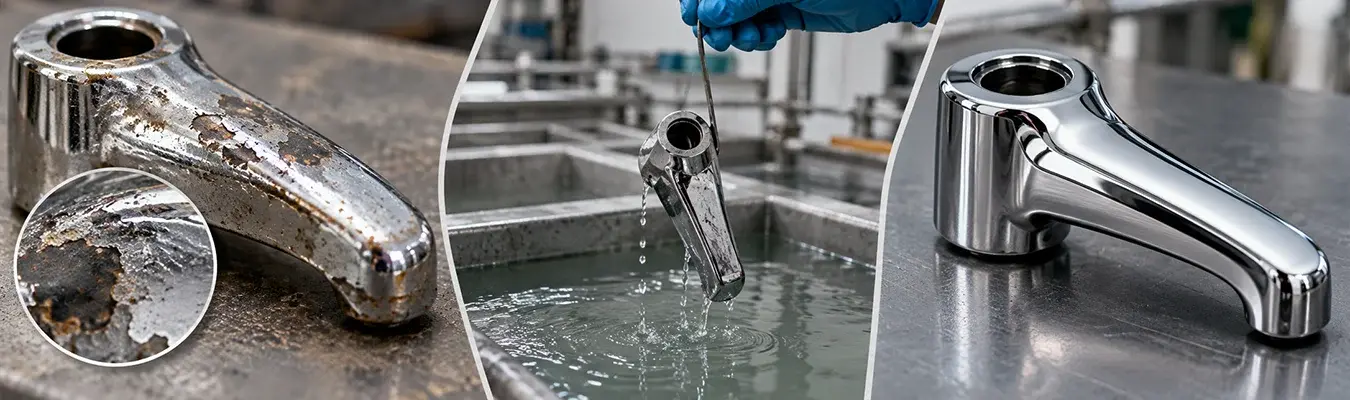
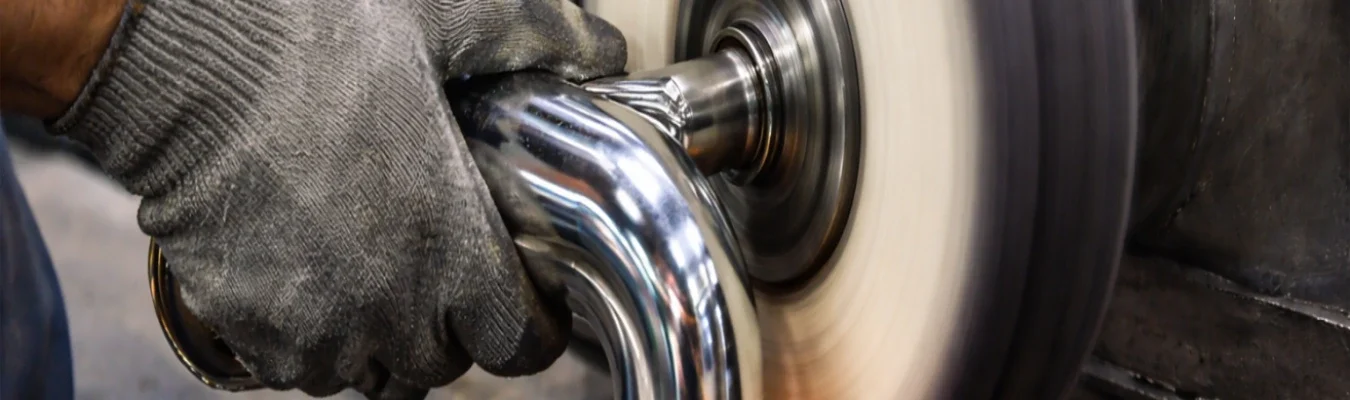
A scratched handrail and a dull one need different fixes, and mixing them up wastes time and metal.
The difference between buffing and polishing is how the abrasive works. Polishing uses abrasive bonded to a wheel or belt to remove material and level scratches. Buffing uses a soft wheel charged with loose compound to refine the surface and raise the shine.
In everyday shop talk the two words overlap, but a high-gloss finish on rough metal needs both, in that order.
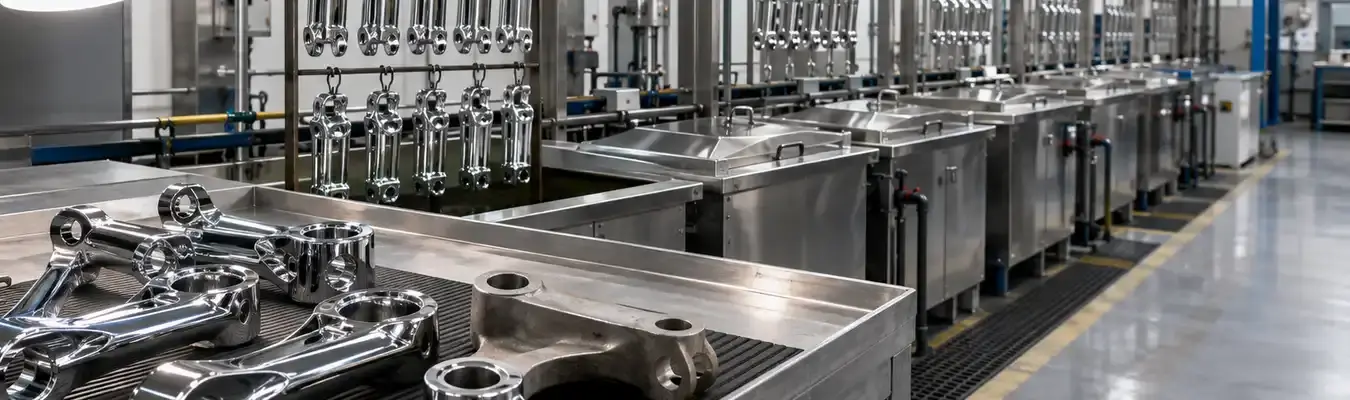
At Al Asriah Metal Coating in Sharjah, we offer metal polishing in Dubai, Sharjah, and across the UAE. We work on brass, stainless steel, ironmongery, and fabricated parts, and we polish parts before and after plating. See our mechanical buffing and polishing services for the full range.
In This Article
- What Is the Difference Between Buffing and Polishing?
- How Does the Polishing Process Work?
- How Does Buffing Work on Metal?
- Which Compound and Wheel Suit Which Metal?
- Which Industries Need Which Finish?
- What Should You Tell Your Finisher?
- Frequently Asked Questions
What Is the Difference Between Buffing and Polishing?
The difference comes down to bonded abrasive against loose abrasive.
| Factor | Polishing | Buffing |
|---|---|---|
| Abrasive | Bonded to a belt, disc, or wheel | Loose, carried in a compound |
| Tool | Abrasive belts, discs, and flap wheels | Soft cloth, sisal, or felt wheels |
| Action | Removes material and levels scratches | Refines the surface with little removal |
| Stage | First | Last |
| Result | A uniform, smooth surface | A bright, reflective surface |
Wikipedia gives the same technical split: polishing uses abrasive glued to the wheel, while buffing uses loose abrasive applied to the wheel.
Each stage depends on the one before it.
How Does the Polishing Process Work?
Polishing is controlled removal of surface flaws, worked from coarse abrasive to fine.
The first stage on unfinished metal starts at about 60 or 80 grit. Each later stage uses a finer abrasive, such as 120, 180, 240, 320, and 400 grit or finer, until the target finish appears.
Polishing targets scratches, weld marks, mill scale, oxidation, and rough patches.
Do not skip grit steps. Jumping from 80 grit straight to 320 grit leaves deep, hidden scratches that compounds cannot remove.
Once the scratch pattern is uniform, the surface is ready for buffing.
How Does Buffing Work on Metal?
Buffing refines what polishing has already levelled, and it raises the shine.
A soft wheel of cloth, sisal, or felt carries a buffing compound. One supplier suggests switching from polishing to buffing at about 400 to 600 grit.
Buffing runs in two steps:
- Cut buffing – A coarser compound and firmer wheel remove the fine marks left by polishing.
- Colour buffing – A finer compound and softer wheel, with lighter pressure, bring up the lustre.
Metal buffing also suits maintenance. A pass with the right compound can restore appearance without a full rework.
The compound decides how far each step goes.
Which Compound and Wheel Suit Which Metal?
Compound colours signal how much each one cuts, and each suits different metals.
| Compound | Role | Suits |
|---|---|---|
| Black emery | Coarse cut for scratches, pits, and rust | Hard metals with heavy marks |
| Brown tripoli | Cut and colour | Soft metals such as brass and aluminium |
| White rouge | Final finish with a light cut | Harder metals, nickel plate, and chrome |
| Green rouge | Colour and brightness | Stainless steel and chrome |
| Red or blue rouge | Polish with no cutting action | Final lustre |
Sisal wheels suit heavier cutting on hard metals. Soft cotton or flannel wheels suit the final colour stage.
Match the compound to the metal before the wheel touches the part.
Which Industries Need Which Finish?
Each industry asks for something different from the surface.
- Food and pharmaceutical – Food-contact stainless steel is usually specified at Ra 0.8 microns or lower, and pharmaceutical work can need finer. Roughness alone does not make a surface hygienic, because welds, geometry, and defects matter too.
- Marine and offshore – Salt and moisture attack imperfections first. One study on laser-built 316L stainless steel found that polishing a rough surface improved its pitting resistance.
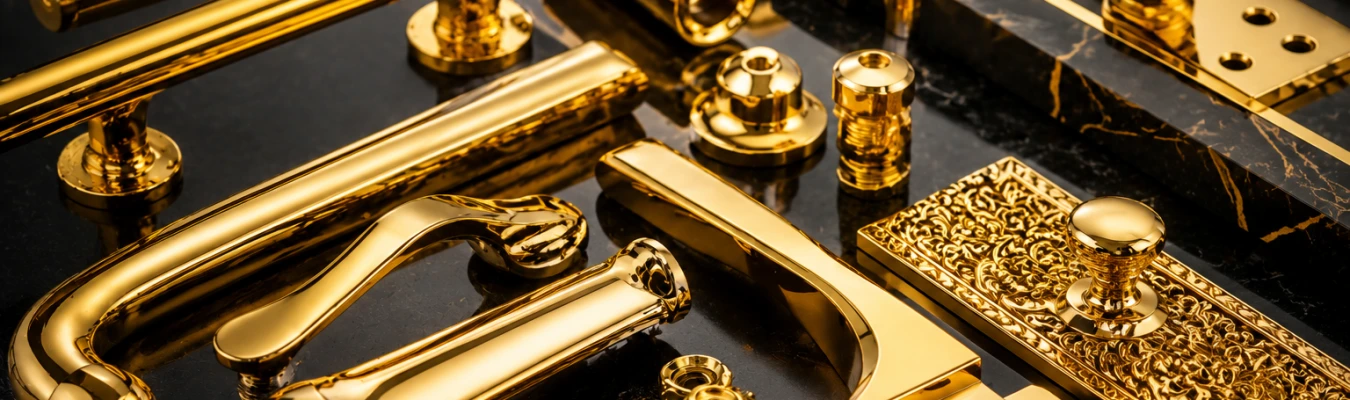
- Architecture and interiors – Handrails, cladding, and ironmongery such as handles and hinges are judged on appearance and longevity, so the finish must be consistent across every piece.
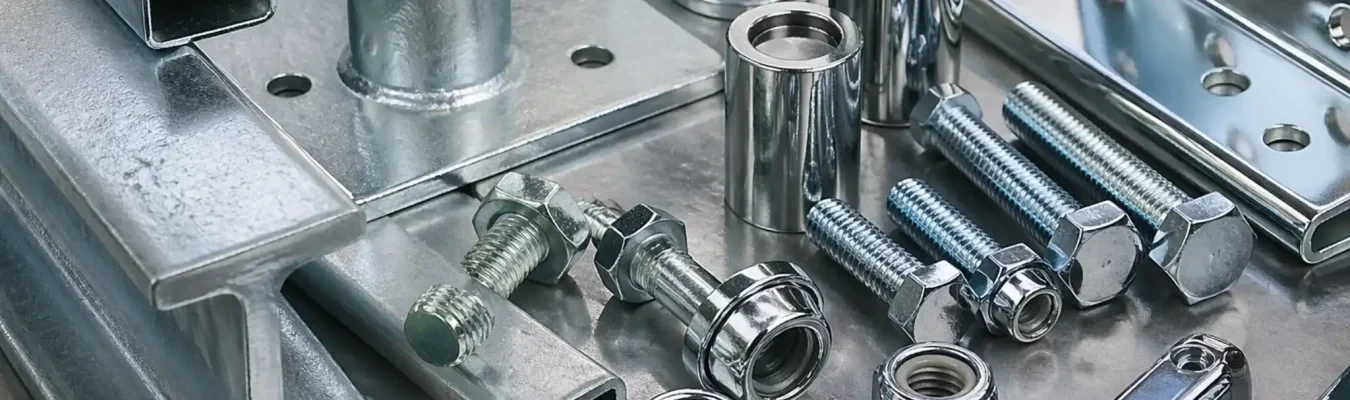
- Plating – Most plating follows the surface and does not level it, so polish and buff first. See our guide to metal fabrication finishing for how that fits the wider process.
Your own metal, starting condition, and target finish decide the sequence.
What Should You Tell Your Finisher?
Six details let a finisher plan the right sequence.
- The base metal – Brass, stainless steel, aluminium, or steel.
- The starting condition – Scratches, weld marks, oxidation, or mill scale.
- The target finish – Satin, brushed, or mirror, or a roughness value in microns.
- What follows – Plating, coating, or no further finish.
- The part size and quantity – Both change the method.
- The goal – Full finishing or a maintenance restore.
Send us your parts and these details, and we will advise on the finishing sequence before we quote. Request a polishing quote.
The questions below cover what buyers ask before they book a job.
Frequently Asked Questions
Is buffing the same as polishing?
Not technically. Polishing uses abrasive bonded to the wheel, while buffing uses loose compound on a soft wheel. In everyday shop talk the words overlap.
Can you buff without polishing first?
On a surface that is already smooth, yes. Buffing cannot remove deep scratches or weld marks, so rough metal needs polishing first.
Can you buff stainless steel and brass?
Yes. Stainless steel buffing works well with green or white rouge, and brass buffing with brown tripoli. Both need the correct compound and wheel.
Does buffing remove scratches?
It removes the fine scratches and haze left by polishing. Deep scratches need polishing first.
What surface roughness do food-grade surfaces need?
The established guideline for food-contact stainless steel is Ra 0.8 microns or lower. Ask your finisher to meet a measured roughness and not just a shine.